…and I am happily peacefully and dangerously writing a book now 🙂
Start Date: Oct 1991 – Present
This is what it’s about…
To the people who have known me and secretly wondered,
“Why is she like that?” —
this is the long, honest answer.
And to the people who haven’t met me yet:
this is really about YOU.
Because the question behind every life is the same —
“Why am I like this?
A Sneak Peek
I’m currently editing the book and working on the illustrations.
It will likely take another two months before it’s ready.
If you’re curious, I’m sharing the first two chapters below—unedited, as they are.
——
Oct 7th, 1991
I was born at home – my grandparents’ home
PART I – THE FOUNDATIONS
BEFORE I KNEW MYSELF
Where the nervous system learned its first language
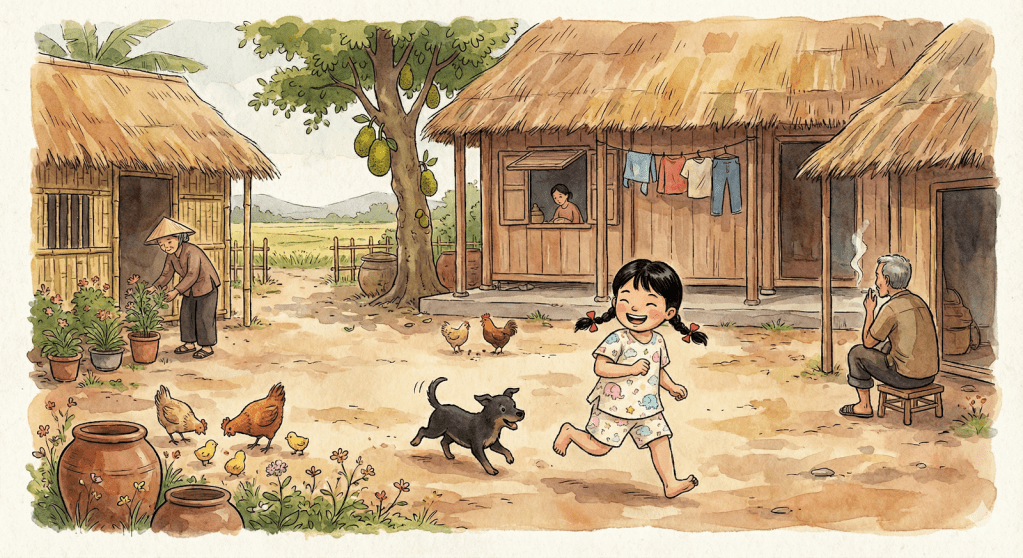
CHAPTER 1: The Kid Who Accidentally Managed the Whole Family
I grew up in a family where the biggest luxury wasn’t money, it was space.
Not emotional space (absolutely none of that),
Not personal space (nonexistent), but literal, physical square meters.
We were poor, but we had three houses:
- Grandma’s house: a tiny wooden kingdom where she ruled with perfectionism and grass threads, weaving sleeping mats from strands so fine they felt like the delicate strength of a woman who had survived too much, and kept going anyway.
- Grandpa’s house: twenty meters away, his personal “I’m done with your grandma” sanctuary.
- The middle house: where my aunts, my uncle, and I all lived like one noisy ecosystem.
Three houses, but if someone coughed in one, the other two heard it.
Walls were made of wood, water-coconut leaves, and hope.
Doors had no locks, or more precisely, the kind of primitive locks that screamed, “Hey, look! This is locked and don’t try to break in, but if you try… a little, you may succeed.” Security was organized like that because life was simple. Most importantly, there was nothing worth stealing.
The simplicity of the outside world, however, didn’t extend indoors: complexity took charge. In my child’s logic, I hadn’t understood why my family argued all the time. Everyone seemed to be busy enough with their work, and instead of resting at the end of the day, they came home and started complaining.
My aunts complained about each other.
My uncle complained about my grandma.
Grandpa complained about my uncle.
My grandma complained about all of them.
And my…
Actually, let’s just say: If quantum physics ever needed a model of infinite permutations, they could study my family arguments.
But one thing never changed:
No one ever shouted at me. They only came to me to share.
I remember before I was taught how to read, I would hold a book and read out loud as if I understood everything. My aunt would sit there with me, trusting in my ability to understand adults’ problems, and she would start to tell me all sorts of stories. Or when my uncle saw me swinging the hammock with a piece of old newspaper in my hands, he would proudly tell my aunts, “Look at her, she could read already,” while knowing clearly that I was speaking… gibberish.
I was the safe zone of the family.
The emotional Switzerland.
The tiny Buddha without the wisdom.
The kid who didn’t know she was keeping the family together… simply by listening.
Back then? When my little family was the only baseline I had, I thought it was normal. Well, I actually had another family—my neighbors across the river—to compare. Their circumstances seemed even more complicated, which made my family not an outlier at all.
Now, after leaving that river, those houses, after seeing other homes and listening to other stories, I began to notice something interesting about family dynamics: People in different places, speaking different languages, were facing similar struggles and tension, with the same people holding more than they were named for and going through the same family negotiations.
But back then? I was the happiest kid running between these houses… completely unaware that I had already become the family mediator, the emotional courier, the unofficial United Nations peacekeeper.
Now I see it clearly: I wasn’t just a kid running between houses.
I was the bridge between people who loved each other, feared each other, misunderstood each other, and couldn’t say “I’m sorry” even if their life depended on it.
Did you recognize yourself here, or does your family have someone like this? The one who absorbs the chaos and turns it into connection.
The stabilizer.
The listener.
The soft landing.
The translator of feelings adults don’t know how to express.
Some families call them ‘the responsible one.’
Some call them ‘the old soul.’
Some don’t even notice them at all.
If you were the child who kept the peace, you were never weak.
You were never too emotional.
You were never ‘mature for your age.’
You were the emotional architect of a home that didn’t know how to hold itself together.
And that is a gift.
One you learned too early, but one that now, finally, belongs to you.
I thought I was just a kid running between three small houses.
But I was actually carrying an entire family across the distance between their hearts.
CHAPTER 2
Grandma—The Original Perfectionist
(Who unintentionally trained another one)
My grandma ran a handmade workshop—the best in town.
She was a perfectionist long before the word ever trended on social media. She made sleeping mats from grass threads. And shopping bags, too—the same kind of bags you now see repurposed in luxury boutiques and tropical hotels. Our sleeping mat had magic: it could regulate the temperature, making the cold season warmer and the summer days cooler.
We had good products, but I didn’t feel proud or appreciate the kind of magic our work could bring to people when they sleep. The motto of ‘Love what you do, good things will come,’ didn’t exist yet in my little brain. All I saw was hardship and back pain.
I often think: if someone had discovered her talent at the right time, we might have been famous. Or at least… less poor.
My grandma couldn’t read.
She couldn’t write either—not entirely true as she could remember how to write her name to sign off important papers.
But she was sharp.
She never missed a deadline.
If someone ordered something, she remembered every detail and delivered it exactly on the day she promised.
Never late. Not once.
We built our reputation on quality and on my grandma.
Her amazing memory was my enemy.
As a kid, I wanted to buy stuff adults thought ‘unnecessary.’ One of the things I always dreamed of was a pencil case—the kind that had a magnet and several compartments. So, I sneakily waited until she was cooking in the kitchen and I reached the pocket of her Áo Bà Ba and stole 500 đồng (less than 2 cents in today’s exchange rate). I needed to do it a few times to collect enough for that pencil case. When I finally got the lovely red pencil case, without investigation, the ‘culprit’ of the family was quickly identified, and a court was set up: she told me exactly how much was missing. That was my first and last Mission Impossible.
To this day, I still wonder why she didn’t get me after my first attempt.
She was also an excellent investor.
Whenever she saved enough money for a small gold ring, she rushed to the market and bought one. Gold didn’t lose value. Gold was safety.
Sometimes, it was hard to spot patterns with my grandma. On the surface, she seemed like a risk-averse person. But she wasn’t just like that. She was part of the Chơi Hụi network—an extremely complex saving and credit system that existed in many rural parts of Vietnam. What she did was to send money every month to the group’s manager’ and the manager would lend that money out to other people and charge them a certain interest. If my grandma kept sending in money without withdrawing, then depending on the agreement, after six months or one year or more, she could get back all her money with some… add-on. That is the simplest way of explaining it, but you get the gist.
The riskiest part of that kind of investment was: If one day the manager decided to take all the money and move somewhere else, you basically lost everything. No legal agreement. No written record. A completely trust-based system.
And my grandma’s ‘wealth managers’ never fled. All her investments came back safely through that risky network. I never knew if it was a skill she had—reading people and trusting the right ones—or simply that luck was on our side. When life was difficult, hard work and hope sprinkled with a bit of risk-taking were a very promising combination, and it often paid off.
She did all of this because she had a dream. Her dream was simple: to build a brick house. That dream came true when I was around thirteen. If it hadn’t been for my school fees and extra classes, it might have happened earlier.
But I know—deep down—my little certificates built her several brick houses or maybe castles in her heart. I was trying to build a whole dynasty for her.
Making mats was slow, precise work. Every single thread had to be inspected and matched in size so the final pattern would look neat and even. Before the threads were ready for production, they had to be dried in the sun, and taking care of them was a fun thing. I was sometimes assigned as a weather forecaster and that meant looking at the sky and spotting dark clouds in the distance. But not all dark clouds would turn into rain, so I had to be careful before announcing the upcoming rain, because people had to stop their work, collect all the thread bundles, and hurry inside. A drop of rain touched the threads? Mold would develop and the color would no longer be beautiful.
That was a very important task during the rainy season. I enjoyed that part more than making the mat.
One sleeping mat—160 by 200 centimeters—took an entire day. From five or six in the morning until eight or nine at night.
My grandma and my aunt Ten were the master artisans.
And me?
I was the grumpy assistant.
I started helping when I was seven or eight.
And yes—that’s exactly where my eye for detail comes from.
‘Hate’ is a strong word.
But I definitely used it for her workshop. Who would want to sit on the floor in a very uncomfortable position and weave hundreds of threads together by hand? There was no loom for this kind of handicraft. Our fingers were heddles and our legs were beams. You would sit on the floor and use all of your limbs for it. As a kid, I obviously wanted to run around rather than become a loom.
Whenever she asked me to help, I lied:
“Con có bài tập về nhà.” (I have a lot of homework today.)
She always knew I was lying.
Always.
But because it involved ‘studying,’ she let the lie live.
That was her love language: strictness paired with silent permission.
She complained constantly that girls didn’t need too much education.
“You’ll grow up, get married, and leave. Why study so much?”
She would say that in the morning.
At night, she would add:
“If you don’t get good grades, I’ll send you to the market to sell lottery tickets. So study well.”
Contradictions were her specialty.
When I was seven, she sent me to a Temple—Tian Hou Temple—to learn Chinese. She didn’t wake up one day and decide that. It was my grandpa’s idea. One afternoon, he saw me writing Chinese. As with most of the things I did when I was a kid, I didn’t know what I was doing—still, I did it with absolute confidence. I wrote every Chinese character I saw on our ancestors’ altar. The confidence and the concentration I had sparked ideas in my grandpa. I didn’t know what he told my grandma but one day, I was brought there for my very first foreign language class.
The same woman who said we couldn’t afford my education was also the one paying my tuition. Every time I announced it was time to pay the fee, she would sigh:
“Learning Vietnamese is enough. Why Chinese? Only one more month, okay?”
And just like that, I continued until I was fifteen.
I earned my Chinese certificate Level C (Advanced Level).
Chinese classes started at six in the evening.
I walked to the temple at five.
When lessons ended two hours later, I stood at the gate and waited.
There were no streetlights back then. My grandma would come with an oil lamp or sometimes with a fancy flashlight if my uncle didn’t take it for his nightly fishing trip. I followed her small silhouette home in silence.
Love was warm just like the light shining around her. That’s how I never missed a lesson.
She was funny, too—in her own way.
She was everything to me: my mother, my teacher, my Marcus Aurelius, my dentist, my doctor.
I rarely went to hospitals. She diagnosed everything herself and always knew exactly what herb, oil, or remedy to find. She didn’t believe in Western medicine—according to her, anything not from nature is dangerous to health. “These modern medicines are all chemicals. Not working.” She confidently concluded.
Once, I had a severe seafood allergy. I had a memorable dinner with clams and I loved them. We didn’t have that often—that night, the boyfriend of my Aunt Ten, who later became my uncle-in-law, wanted to impress his future in-laws and the-one-and-only kid of the family, who had the utmost power to decide whether he would be accepted or not. So, he kept feeding me and I kept eating. Quietly—I approved the clams and I approved my ‘uncle-in-law.’
Nothing happened until midnight. I woke up feeling dizzy. I drank water nonstop and swelled up so much I nearly doubled in size. All night, my grandma sat beside me, fanning me, giving me water. She was so calm as if she had experienced this several times before. So, as usual, I trusted her, and she patted my back slowly until I fell asleep again. We slept on the floor— the softest thing I felt was her hands.
Moments like that get recorded by the body immediately.
Later in life, your body recognizes this kind of love again—and it also recognizes the absence of it.
By morning, I was fine.
My grandma didn’t believe in allergies. No one in our family had them. So she concluded I simply wasn’t resilient enough. She kept feeding me seafood—smaller doses. I kept reacting.
Until one day… I didn’t. Now the only allergy I have is bad food.
She complained a lot.
But she forgave easily.
During the war in the 1960s, a bomb fell on the bunker.
Her kneecap was destroyed. It never healed.
She told me stories about the hospital—how kindly the American nurses treated her, how it was the first time she ever saw canned food.
She didn’t hate them.
She almost never said she loved anyone in my family, all she did was complain about them, expressing how disappointed she was in them. But at night she would stay up late just to wait for my uncle to come home and then she could sleep. She could be sharp with words, but she broke easily inside.
That’s how I learned to question criticism:
Is this about me—or about someone trying to protect themselves?
If anything, my grandma taught me this:
Love doesn’t need to be spoken. It works harder than words.
If these stories resonate with you and you’d like to read the book when it’s finished, you can leave your contact here.
I’ll send it to you when it’s ready.
 Hi, I'm Dai and I'm from Vietnam 🚀
One thought on “…and I’m writing a book”