Vietnam National University – Ho Chi Minh City
University of Social Sciences and Humanities
Faculty of English Linguistics and Literature
——————————————-
Course: Social Issues in the US
Ho Chi Minh City – April 2013
Illegal immigration is a controversial problem in the United States since it has both positive and negative impacts on the US economy. Many Presidential Administrations from George Bush to Barack Obama and others before them admit that the US immigration system is outdated and needs reform. However, there is still little change in the immigration policy due to the important role of illegal immigrants in the US economy. In 2008, illegal immigrants accounted for 5,4 percent of the US civilian labor force (Jeffrey S.Passel and D’Vera Cohn, 2009). In a recent estimate from the Council of Economic Advisers, immigrants in general contribute about $37 billion a year to the US economy (1) and because of this, it is impossible to single out illegal immigrants from the US economy for several reasons. The purpose of this paper is to find out the answer to the two questions 1) How does illegal immigration affect the US economy? 2) Does the contribution of illegal immigrants outweigh the negative effects it has on the economy?
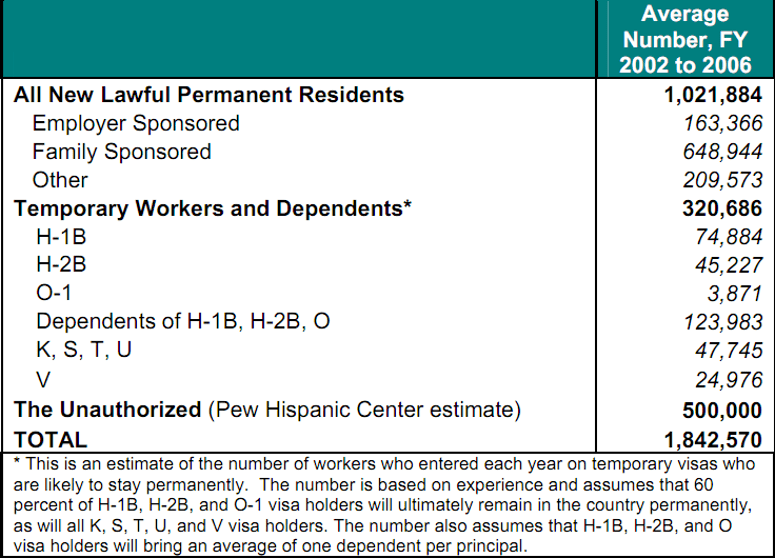
The USA is known as a country of immigrants. The annual level of immigration averaged about 1.8 million between the fiscal years 2002 and 2006. According to table 1, on an average of every 1.8 million annual immigrants, there are 500 thousand unauthorized or illegal immigrants who enter the US unofficially or overstay legally permitted periods of entry and have no legal rights or status. As the Pew Hispanic Center estimated there were about 11.1 million illegal immigrants living in the US in 2012. This is not a small number therefore their contribution to the US economy is considerable and undeniable.
Figure 1.
Source: Pew Hispanic Center
There are several reasons explaining why there are many illegal immigrants in the US. Firstly, compared to the past the number of educated and skilled people in the US is higher. In 1965, only 5,921 thousand students attended college programs and in 2012 the number reached 21,557 thousand, over 4 times higher (2). Moreover, the number of US-born working-age adults who had not completed high school is just 8 percent (Gordon H. Hanson, 2009). The number of skilled US-born workers is increasing; the need for low-skilled workers at the same time is also increasing. Therefore, employers see illegal immigrants as an important source for low-skilled jobs such as agriculture, maintenance, construction, and other jobs which require more physical strength than education. Secondly, illegal immigrants can earn much more in the US than in their homeland even after balancing the differences in expenditure between the two countries. The income in the US can be 2.5 times higher. These two main reasons encourage people who do not have illegal conditions to enter the US, trying to find ways to illegally stay and work in this country.
The first impact illegal immigrants have on the US economy is that they make the economy’s productivity growth. This impact can be considered a positive one. According to Giovanni Peri, an economist at the University of California, in the states with more illegal immigrants, skilled workers make more money and work more hours which leads to the growth in economy’s productivity, and between 1990 and 2007, illegal workers had increased legal workers’ pay in complementary jobs by up to 10 percent. (3) However, at the same time, they cause trouble for the US native-born – less educational workers. Employers obviously prefer illegal workers because they can bring more benefits to their businesses. If a low-education worker wants to win over an illegal worker for the same position, he or she will be lowered salary. And sometimes illegal workers join the battle with skilled workers. There are two choices for the skilled workers, they can either accept the job with a lower wage or refuse the offer. With illegal interference, there are definitely undeniable negative economic effects on native citizens. Employers tend to favor illegal immigrants as their workers since these people are not able to be eligible for any kind of welfare programs which make them less paid than low-skilled native workers. Generally, illegal immigrants will create benefits for employers which leads to an increase in national income, and at the same time, they put more pressure on and reduce the earnings of lower-skilled and sometimes educated native workers.
Secondly, there is an argument that illegal immigrants have become a burden on the national budget. In this paper, I will focus on the imbalance between the tax collected and the budget spent on health care and education for illegal immigrants. Even though illegal immigrants help to increase productivity and as a result increase the national income, they also appear to be the group that exceeds the cost of the services they use. To deal with this problem, the state and local governments have to incur the cost of providing services for illegal immigrants. One of the reasons to explain it is that most illegal immigrants in the US have low-income jobs mainly in agriculture, maintenance, construction, etc., and because of this the tax together with other kinds of fees they have to pay for the government is also low compared to US-born native citizen and the costs that the government incur for services they use especially the ones related to health care and education.
Education is one of the most costly expenditures that the state and local governments have to incur for illegal immigrants. In 1982, the Supreme Court stated that children may not be excluded from public school due to their immigration status. The second generation who are born to illegal immigrants in the US will receive the same education in public school as the US-born native citizens because they are considered to be US citizens. The significance of this is that the money paid for their education is higher than the native-born’s. Because they are born to illegal immigrants, their English is not as good as that of native-born students. As a result, the costs incurred for their English proficiency classes will be 20 to 40 percent higher than the native ones (Cardenas, Jose A. and others, 1976) (Albert Cortez, 2004). Illegal students make up about 4 percent of the school-age population (A CBO paper, 2007) and the average annual cost for a student born to illegal immigration is about $7,500 per student and $11.2 billion in 2006 for the total costs of providing education to these students. This number reached $30 billion in 2009 (S&P Study, 2009) and with a steady annual number of illegal immigrants to the US, the costs for education can be higher in the future obviously this number is not small which puts great pressure on the state and local budget spending.
Besides, the budget spending on illegal immigrants using services in the health care system is considerable. The Census Bureau estimates that immigrants both legal and illegal are between 2 and 2.5 times more likely to lack health insurance (Robert J. Mills, Shailesh Bhandari, 2003). However, they still can use emergency rooms and public clinics for health care services related to children, pregnant women, families with dependent children, and elderly or disabled individuals by getting Medicaid coverage. Officially, these illegal immigrants are not able to be eligible for Medicaid due to their lack of health insurance; they are, however, acceptable for emergency cases mentioned. Another reason explaining why illegal immigrants are less likely to have health insurance is that immigrants both legal and illegal are somehow younger and healthier than US-born citizens (Leighton Ku, 2009). The costs they use for emergency health care services will be incurred by the state and local budgets. For all of the mentioned reasons, it usually appears like these illegal immigrants receive more than what they have paid through tax collection. As a result, the amount of budget spending for health care services is increasing day by day due to the fact that the annual number of illegal immigrants is growing steadily.
While reconsidering the positive and negative effects that illegal immigrants have on the US economy, there is an argument that illegal immigrants are exploiting the US economy because they are using services that cost more than the tax they pay to the government. Compared to the US citizens who have to pay higher taxes and pay fees for other services in order to use them eligibly, illegal immigrants, however, pay less and use more. For example, in Colorado, the annual cost of education for illegal immigrants is between $217 and $225 million while the tax collected from them is only between $159 and $194 million (Robin Baker and Rich Jones, 2006) (Elizabeth Burger, 2006) (Baker and Jones, 2006). There is a big gap between the costs and the collected tax, and this causes an imbalance in the state and local budget spending and this causes a great effect on the US economy. Even though there are efforts to lessen the costs of budget spending on illegal immigrants, little change can be made. According to the Congressional Office – a federal agency within the legislative branch of the US government providing data to Congress, in 2007 the costs incurred for the using services of illegal immigrants is higher than the tax revenues they generate for the government and there are limited options or ways to minimize these costs. These costs, however, account for a small percentage of the total costs that the state and local government spent for US citizens in general (A CBO paper, 2007).
According to Chart 1, illegal immigrants are accounted for a small percentage of the US total population. However, its effects on the US economy are considerable and worth debating because it is fundamental to know whether their impacts are more positive or negative. In general, most people agree that there are more benefits than drawbacks. Illegal immigrants come to the US with the American Dream meaning that they want to have a better life by working hard to earn more compared to what they can earn in their own country. Some illegal immigrants try to integrate into the US society by finding stable jobs, and making their own businesses and when having children they will send them to public schools, and this leads to some arguments for education spent on their children. However, this expenditure is just a small percentage compared to the total number of spending for US-born citizens, so it is hard to conclude that illegal immigrants are exploiting and serving as a thread to the US economy. In other words, the contribution of illegal immigrants to some extent outweighs the negative effects they have on the US economy. Moreover, while many people are paying so much attention to legal status, it is better to think more about these illegal immigrants’ education. It is undeniable that illegal with high education makes a bigger and more positive contribution to the US economy.
Chart 1.

Source: http://immigration.procon.org/view.resource.php?resourceID=000844#I
The limitation of this paper is that it lacks generalization. Firstly, most of the information used in the paper is estimates at a certain point in illegal immigrants’ life, meaning that it needs a more forward-looking view. The effects of illegal immigrants should be studied for the entire of their life, not just the time that they can work and contribute to the national income. Secondly, according to economist Madeline Zavodny, for such children who are US citizens at birth, even though they are theoretically US citizens, some studies still consider them as immigrants and this issue is still debatable. Therefore, some may not agree with this when I mention the education and health care spent on these children as US citizens.
For decades, illegal immigration has become a debatable and controversial issue in the US. After considering the impacts of illegal immigrants on the US economy, especially on jobs and wages, and budget spending related to education and health care, the effects they create are two-sided. However, having analyzed the data and information, I believe that the benefits that illegal immigrants have on the US economy are more important because they are contributing more and more to the US economy while the services they are using cost a small sum of money in the local and state budget.
Reference
Works Cited:
A CBO paper, The Impact of Unauthorized Immigrants on the Budgets of State and Local Governments, pp.8, Congressional Budget Office, Dec. 2007.
Albert Cortez, Insufficient Funding for Bilingual Education in Texas, IDRA Newsletter – San Antonio: Intercultural Development Research Association, 2004.
Baker and Jones, State and Local Taxes Paid in Colorado by Undocumented Immigrants, Issue Brief No. 3, Denver: The Bell Policy Center, June 30th 2006.
Cardenas, Jose A., and others, Bilingual Education Cost Analysis, San Antonio: Intercultural Development Research Association, 1976.
Elizabeth Burger, Immigration in Colorado: State Impact and Recent Legislation, Legislative Council, Staff Issue Brief No. 04-06, Denver: Colorado General Assembly, 2006.
Gordon H. Hanson, The Economics and Policy of Illegal Immigration in the United States (pp.8), University of California – San Diego and National Bureau of Economic and Research, 2009.
Jeffrey S. Passel and D’Vera Cohn, A Portrait of Unauthorized Immigrants in the United States, Pew Hispanic Center, 2009.
Leighton Ku, Health Insurance Coverage and Medical Expenditures of Immigrants and Native-Born Citizens in the United States, American Journal and Public Health, Vol 99 No.7 pp.1323, July 2009.
Robert J. Mills, Shailesh Bhandari, Health Insurance Coverage in the United States: 2002, Bureau of the Census, 2003.
Robin Baker and Rich Jones, Costs of Federally Mandated Services to Undocumented Immigrants in Colorado, Issue Brief No.4, Denver: The Bell Policy Center, June 30th, 2006.
S&P Study, Costs and Benefits of Undocumented Immigrants, pp.2, Hispanic News, May 1, 2009.
Websites
(1) What’s the economic impact of illegal immigration? Why target employers, updated on Oct 7th 2007, retrieved on March 27th 2013 from http://www.nbcnews.com/id/19462758/#.UVkrvRy-2So
(2) College enrollment in the United States from 1965 to 2011 and projections to 2021 for public and private colleges,retrieved on March 27th 2013 from http://www.statista.com/statistics/183995/us-college-enrollment-and-projections-in-public-and-private-institutions/
(3) Do illegal immigrants actually hurt the US economy?, published on February 12th 2013, retrieved on March 27th 2013 from http://www.nytimes.com/2013/02/17/magazine/do-illegal-immigrants-actually-hurt-the-us-economy.html?pagewanted=all&_r=2&
 Hi, I'm Dai and I'm from Vietnam 🚀